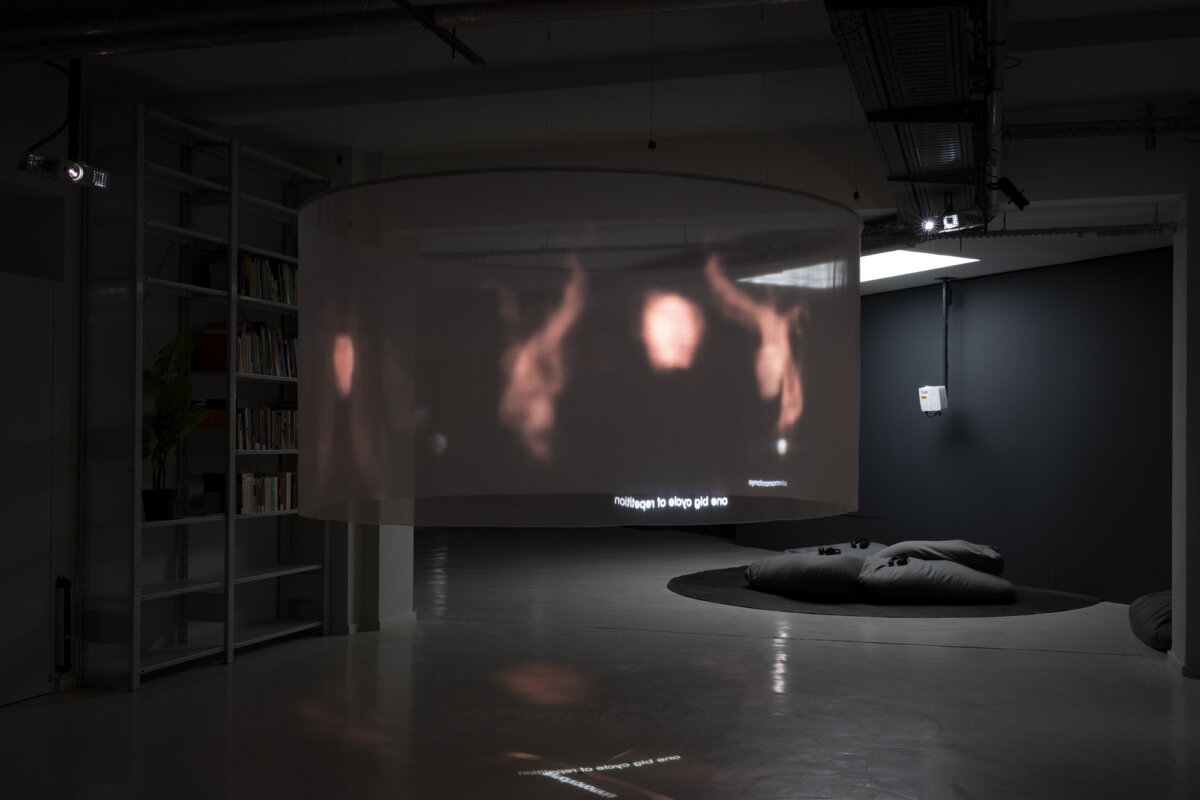
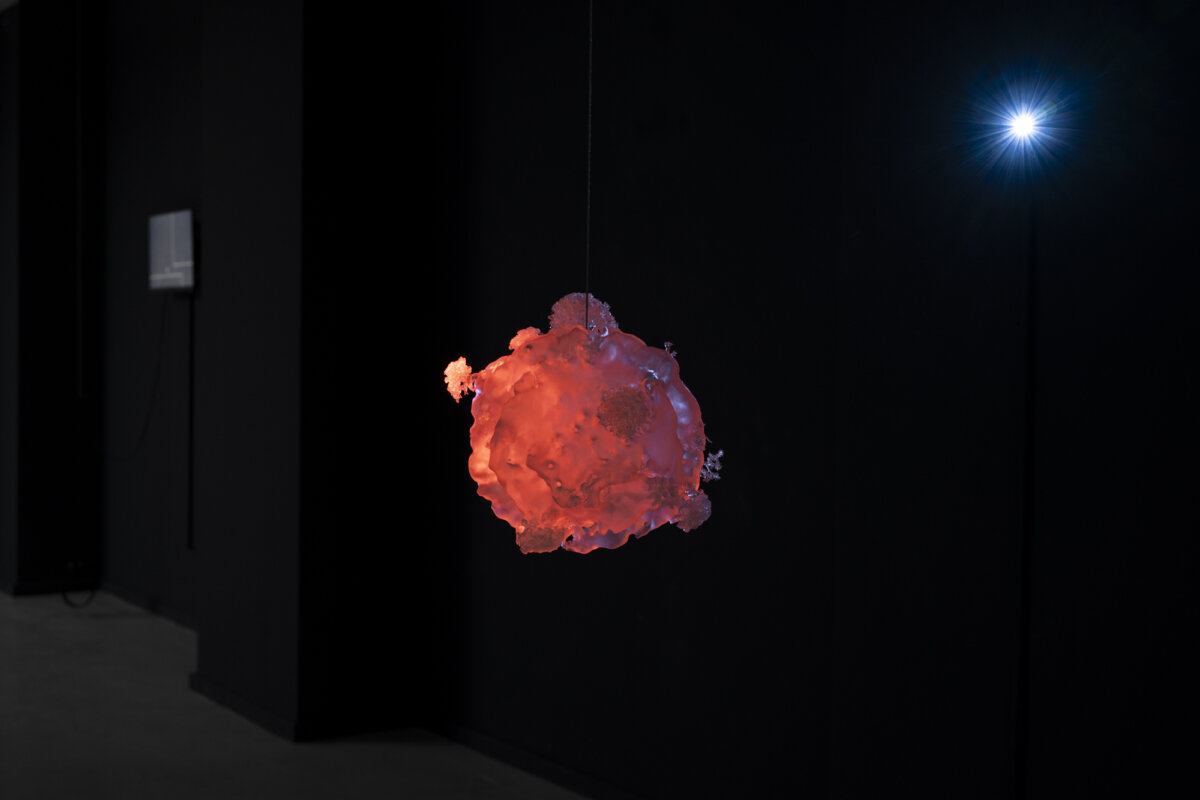
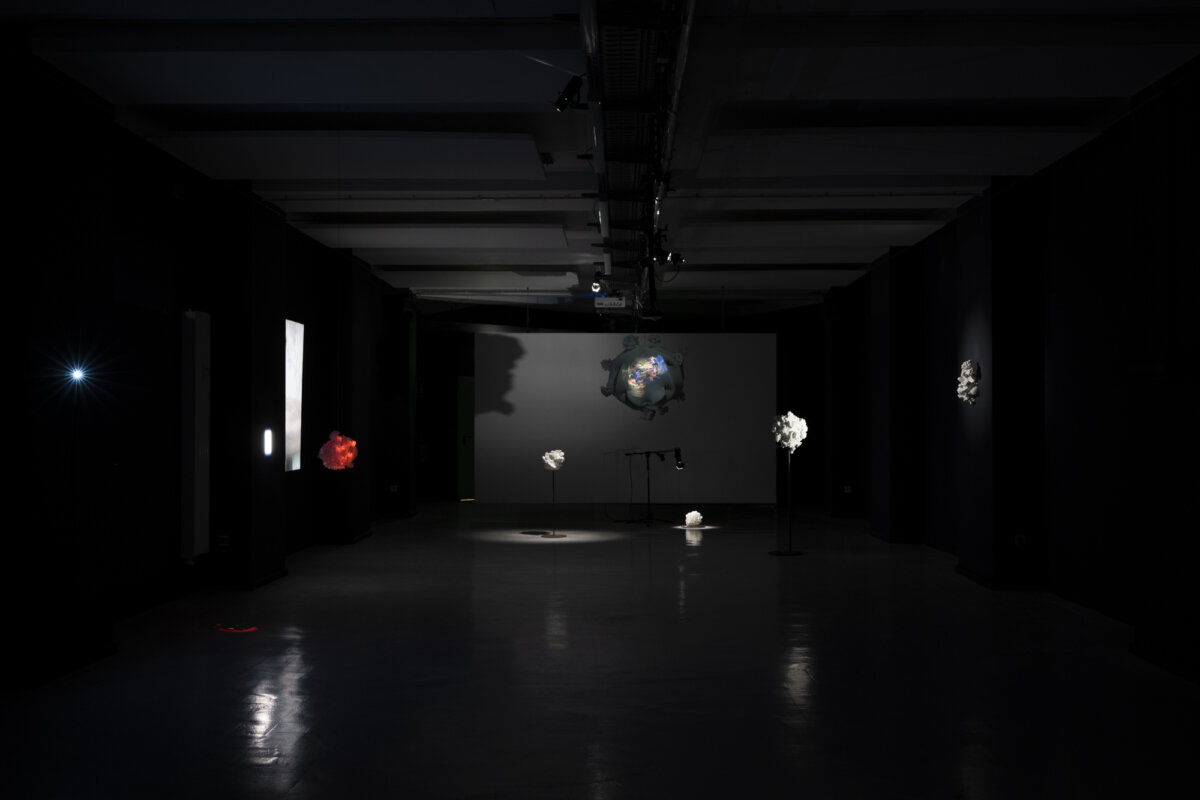
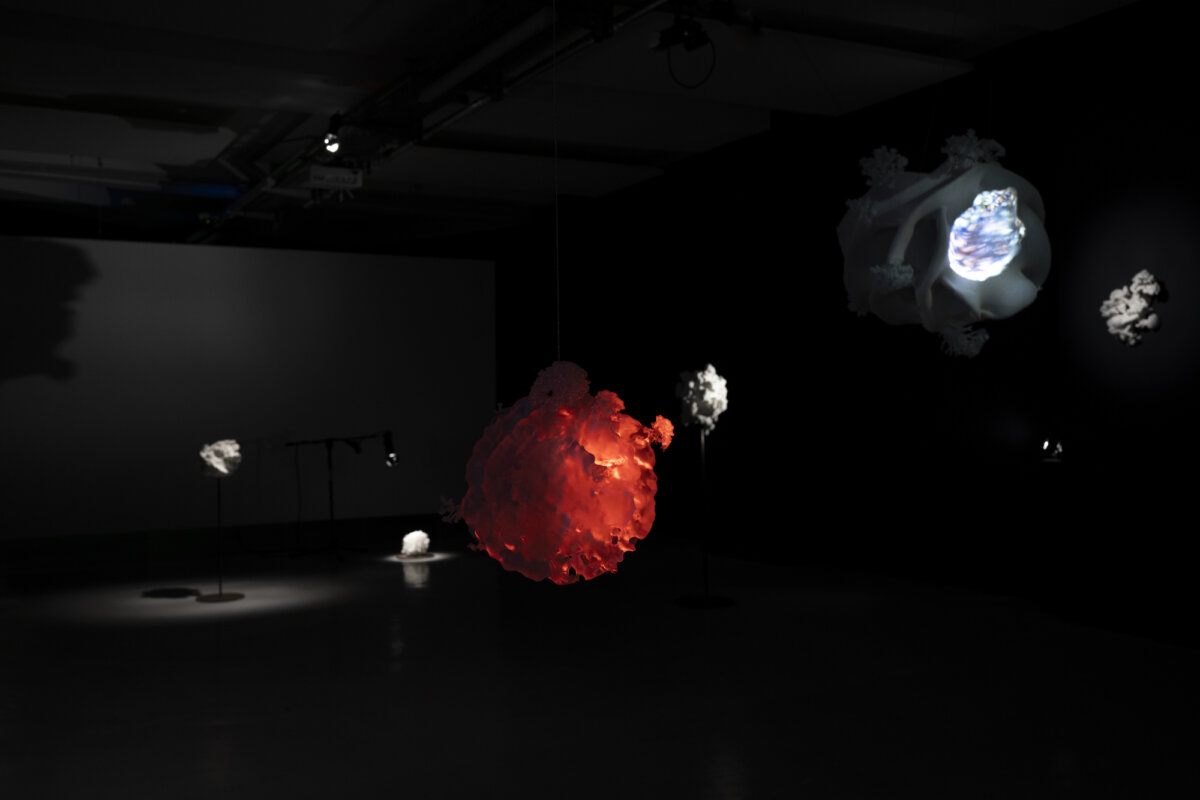
Emergence: Hidden States and Other Worlds is an experimental research project into technological systems whose operation is based on the continuous re-differentiation of interconnected systems, making visible what often escapes formalisation. The work is a generative installation operating across projection mapping, video, and 3D prints.
Different layers of data are fed into the system: WiFi signals that detect the presence of people in the room, dark matter signal data built from real observations of the southern hemisphere sky by the Dark Energy Survey, data from bot activities across the internet, a quantum algorithm, and satellite imagery of the monte nativo in Argentina, the native forest and scrubland of the country’s interior, an ecosystem under pressure from deforestation and agricultural expansion. This multi-output system offers a visualisation of the complexity through which a single movement is infinitely connected to everything around it. Each form it produces appears as one of six slices of a Calabi-Yau manifold, a six-dimensional geometric structure from string theory, whose hidden dimensions are thought to underlie the physical universe, projected here into three dimensions.
Acknowledgements:
Gastón Giribet, Physicist and philosopher; Eng. Gustavo Courault; Raphael Baur, ETH AI Center: thank you for the inspiring talks and great recommendations.
Eng. Francisco Mainero: Structure and programming of the first module.
Prof. Javier Tiffenberg, DF-FCEyN, UBA: Tomographic weak gravitational lensing convergence maps from the Dark Energy Survey covering a band of the southern sky.
Federico Holik, Quantum physicist: quantum algorithm.
Ana Rubinstein, 3D animations and video edition.
Eric Sauerhering, CSI wifi setting.
Ben Creeck 3D printing.
Emergence: Hidden States and Other Worlds is part of the coExistence Residency in collaboration with HEK (Basel, Switzerland) and Pleamar (Mar del Plata, Argentina), made possible with the support of Pro Helvetia.
Related Events
- 07.11.26.18:00– 20:00Emergent Conditions Artist Talk & Séance
mit Amanda E. Metzger, Laura Benech, Zeno Gries
Moderiert von Anna-Lena Panter
- Artist Presentation
silent green / transmediale studio - 03.11.26.18:00– 22:00Emergent Conditions
mit Amanda E. Metzger, Laura Benech, Zeno Gries
- opening
silent green / transmediale studio
Related Media
 Laura Benech, Emergence: Hidden States and Other Worlds, installation view at Emergent Conditions, 2026
 Laura Benech, Emergence: Hidden States and Other Worlds, installation view at Emergent Conditions, 2026
 Laura Benech, Emergence: Hidden States and Other Worlds, installation view at Emergent Conditions, 2026
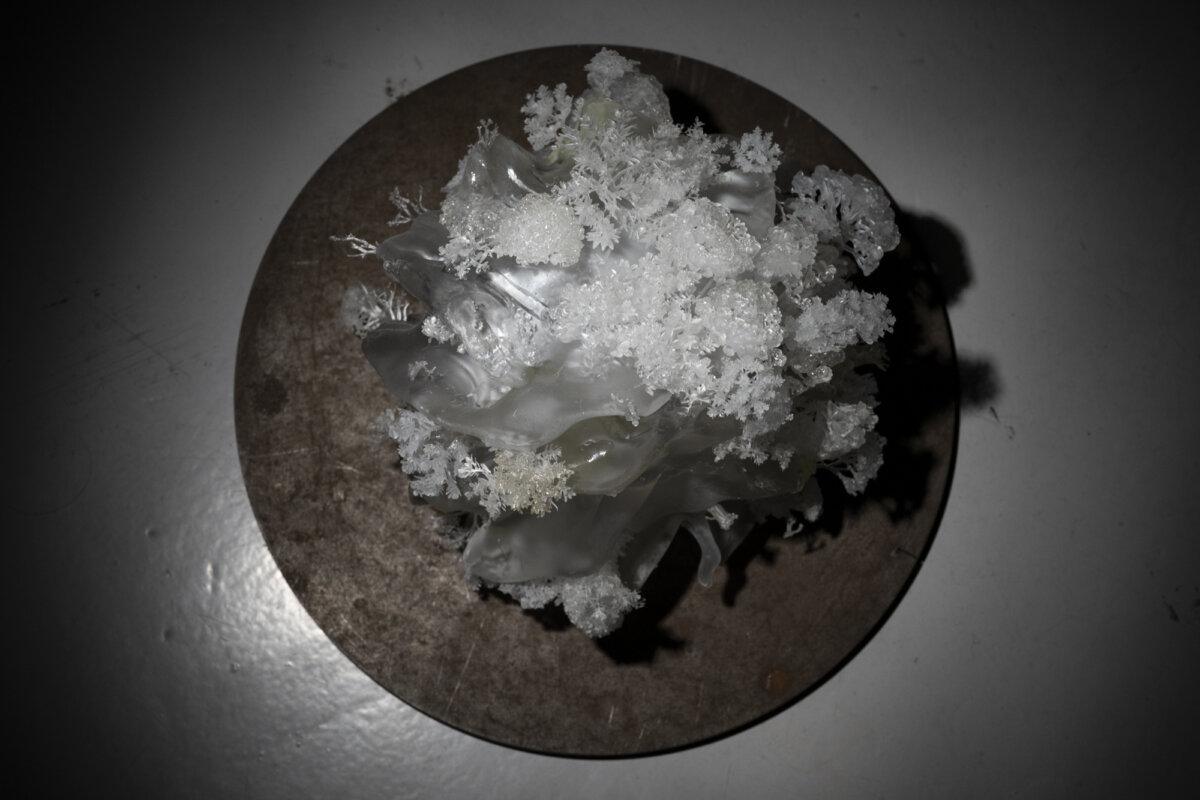 Laura Benech, Emergence: Hidden States and Other Worlds, installation view at Emergent Conditions, 2026